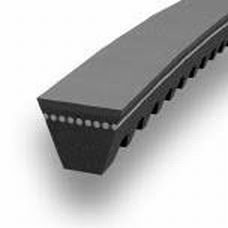
High-performance narrow wedge belt with raw edges, designed for modern industrial drives with extreme speeds and small pulley diameters, where maximum energy efficiency and minimal installation dimensions are required.
XPZ Profile: Narrow raw edge profile with a width of 10 mm. Thanks to precision-ground sidewalls, the belt achieves a perfect fit in the groove, which dramatically reduces vibration and noise even at peripheral speeds exceeding 40 m/s.
Cogged Inner Profile: The specific geometry of the teeth significantly increases belt flexibility while enlarging the cooling surface area. This enables safe and stable operation on very small pulleys without premature fatigue cracking of the backing or overheating of the core.
SKF EPDM Construction: The core consists of a specially formulated compound (often EPDM-based) with transversely oriented fibers, which surrounds low-stretch polyester tension cords. This structure ensures high transverse rigidity and excellent resistance to shock loads.
Raw Edge Design: Unlike wrapped belts, this design allows direct contact of the rubber compound with the pulley flanks. This results in a higher coefficient of friction, virtually zero slip, and more energy-efficient operation with minimal losses.
"Match and Forget" Tolerance: Thanks to state-of-the-art manufacturing technology, SKF guarantees length accuracy for the XPZ range that meets the strictest global standards. Belts of the same size can be combined into sets as desired, without the need for additional matching by batch.
Top Resistance: The belt is fully antistatic according to ISO 1813 and exhibits excellent resistance to mineral oils and dust. Thanks to premium compounds, it can handle an extreme temperature range from -40 °C to +110 °C (short-term up to +130 °C).
Interchangeability: XPZ belts are a higher performance and more flexible replacement for wrapped SPZ belts. They are also fully interchangeable with the classic 10/Z profile or the automotive AVX10 profile.
Installation: This belt is installed on pulleys of the SPZ profile.