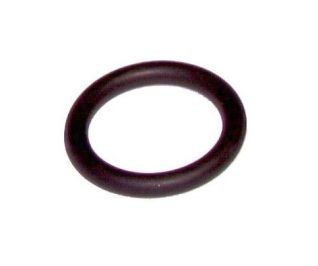
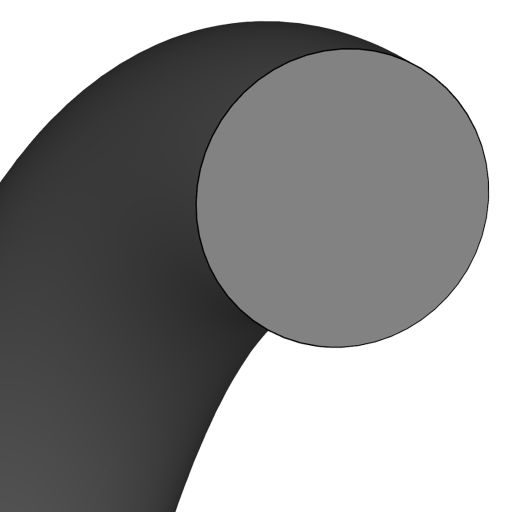
An O-ring is a circular seal of precise dimensions in accordance with the DIN ISO 3601 standard. Â Its sealing function is caused by the deformation of the circular cross-section of the ring in the installation space of the housing. The compression of the cross-section can be in the radial or axial direction.Â
The O-ring has an internal diameter d1=220 mm and a cross-section diameter d2=5 mm. It is made of synthetic EPDM rubber, which has very good resistance to most chemicals and excellent resistance to weathering, ozone, and aging. It can operate at both low and relatively higher temperatures.
Properties of EPDM rubber:
Excellent weather and ozone resistance: EPDM exhibits outstanding resistance to UV radiation, ozone, oxygen, and weathering, making it ideal for outdoor use.Â
Good temperature resistance: EPDM is stable in a temperature range of approximately -40 °C to 120–150 °C, making it suitable for both extremely cold and hot environments.
Chemical resistance: EPDM is highly resistant to a range of chemicals, including weak acids, bases, glycols, and ketones. However, it is not suitable for use in environments with petroleum products, gasoline, or other non-polar substances, which can cause it to swell or degrade.Â
Excellent resistance to aging and oxidation: This rubber is very stable even after long periods and exposure to demanding conditions. Its properties do not deteriorate during long-term use, ensuring reliability in applications where a long service life is important.
Good mechanical properties: EPDM has good elasticity, tensile strength, and tear resistance. Although it is not as strong as some other synthetic rubbers, its flexibility and compression set resistance make it ideal for seals and sealing applications.Â
Excellent electrical insulation properties: Due to its high electrical resistance, EPDM is frequently used in electrical insulation applications.