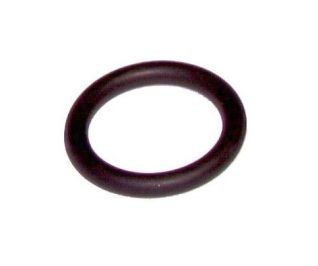
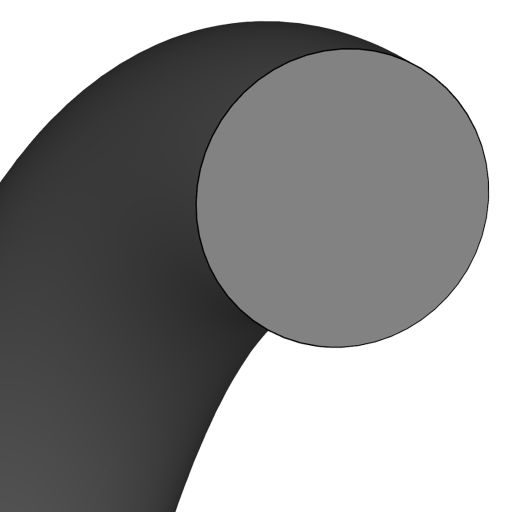
An O-ring is a circular seal of precise dimensions in accordance with the DIN ISO 3601 standard. Its sealing function is achieved by the deformation of the ring's circular cross-section within the installation housing. The compression of the cross-section can be in either a radial or axial direction.
The O-ring has an inside diameter of d1=89.2 mm and a cross-section diameter of d2=5.7 mm. It is made of synthetic EPDM rubber, which has very good resistance to most chemicals and excellent resistance to weathering, ozone, and aging. It can operate at both low and relatively higher temperatures.
Properties of EPDM rubber:
Excellent weather and ozone resistance: EPDM exhibits outstanding resistance to UV radiation, ozone, oxygen, and weather conditions, making it ideal for outdoor use.
Good temperature resistance: EPDM is stable in a temperature range from approximately -40 °C to 120–150 °C, making it suitable for both extremely cold and hot environments.
Chemical resistance: EPDM is highly resistant to a wide range of chemicals, including weak acids, bases, glycols, and ketones. However, it is not suitable for use in environments with petroleum products, gasoline, or other non-polar substances, which can cause it to swell or degrade.
Excellent aging and oxidation resistance: This rubber is highly stable even after extended periods and exposure to harsh conditions. Its properties do not deteriorate with long-term use, ensuring reliability in applications where a long service life is important.
Good mechanical properties: EPDM has good elasticity, tensile strength, and tear resistance. While not as strong as some other synthetic rubbers, its flexibility and compression set resistance make it ideal for seals and sealing applications.
Excellent electrical insulation properties: Due to its high electrical resistance, EPDM is frequently used in electrical insulation applications.