The right lubricant: how to choose it and why it matters?
7 min.
Lubricants are not just about reducing friction. Their function is broader, and they play a key role in several aspects of industrial operations: they protect surfaces against corrosion, dissipate heat, form a barrier against dust and dirt, and in oil systems, they help remove wear particles from the contact area.
Grease or oil – how to decide?
According to their form, we distinguish two basic groups:
Greases have a thicker consistency and stay where they are applied. They are suitable where it is not practical or possible to relubricate too often – for example, bearings, hinges, or joints. They form a physical barrier that also protects against moisture and dirt.
Oils are more fluid and are particularly suitable for closed systems where heat dissipation or lubricant delivery to multiple locations at once is required. They are used in gearboxes, hydraulics, or machine tools.
Every operation has different requirements
In addition to form, the key properties of the lubricant also matter. These are what determine whether the lubricant actually works in a specific operation:
- Viscosity – indicates how "thick" or "fluid" the lubricant is. Too low viscosity means the lubricating film breaks under load and the component is not sufficiently protected. Too high viscosity, on the other hand, increases resistance and can lead to overheating. The correct viscosity depends on the speed, temperature, and load of the machine.
- Additives – lubricants are enriched with various additives that expand their properties. EP (Extreme Pressure) additives protect surfaces under shock or extreme loads. Anti-corrosion additives extend protection even in humid environments. Antioxidants slow down lubricant degradation and extend its service life.
- Temperature resistance – each lubricant has a temperature range in which it functions correctly. Below the lower limit, it solidifies and does not provide sufficient lubrication during startup. Above the upper limit, it decomposes, oxidizes, or leaks. The operating temperature of the machine must always be within the tolerated range of the lubricant.
- Load and type of movement – a high-speed electric motor bearing requires a different lubricant than a slow-moving pin on a press or agricultural machinery. It depends on whether it is rolling or sliding contact, what the speed is, and how the load changes over time – whether it is constant or shocking.
- Resistance to water and dirt – in operations where there is a risk of contact with water, moisture, or aggressive substances, a lubricant with good resistance to washout and corrosion is needed. Standard universal grease is not sufficient in such an environment.
The most common lubrication mistakes
Most problems with bearings and moving parts do not arise from age wear, but from poor lubrication.
What to watch out for:
Incorrectly selected lubricant – using a universal grease where a lubricant with high temperature resistance or special additives is needed is one of the most common causes of premature failure. Different machines and conditions require different solutions.
Too much or too little – the amount of lubricant plays a bigger role than it seems. A shortage leads to seizing, while an excess causes overheating and can damage seals. The correct amount is exactly as much as the component needs.
Wrong interval – relubrication is necessary when the old lubricant is still functioning – not only when the machine starts behaving differently. Intervals vary according to operating conditions: in a standard environment, relubrication once every 6–12 months is sufficient, in demanding conditions (vibrations, moisture, dust) every 1–3 months, in extreme cases even every 24 hours to 7 days.
Contamination – dirt introduced during lubrication causes internal abrasion. Always use clean tools and ensure that ambient dirt does not get into the lubricant.
Lubricant in the wrong place – it is not only important how much lubricant you apply, but where it actually gets. In bearings, the lubricant must travel directly to the rolling elements, otherwise it will not perform its function.
Our range of lubricants – which operations they are suitable for
In our range, you will find lubricants from four proven brands – SKF, Schaeffler, ORLEN, and Kramp. Each of them covers a different segment: from premium products for demanding industrial applications to reliable, economical solutions for daily operations.
In the following overview, we present the best-selling lubricants from each range – their key properties and the type of operation they are best suited for.

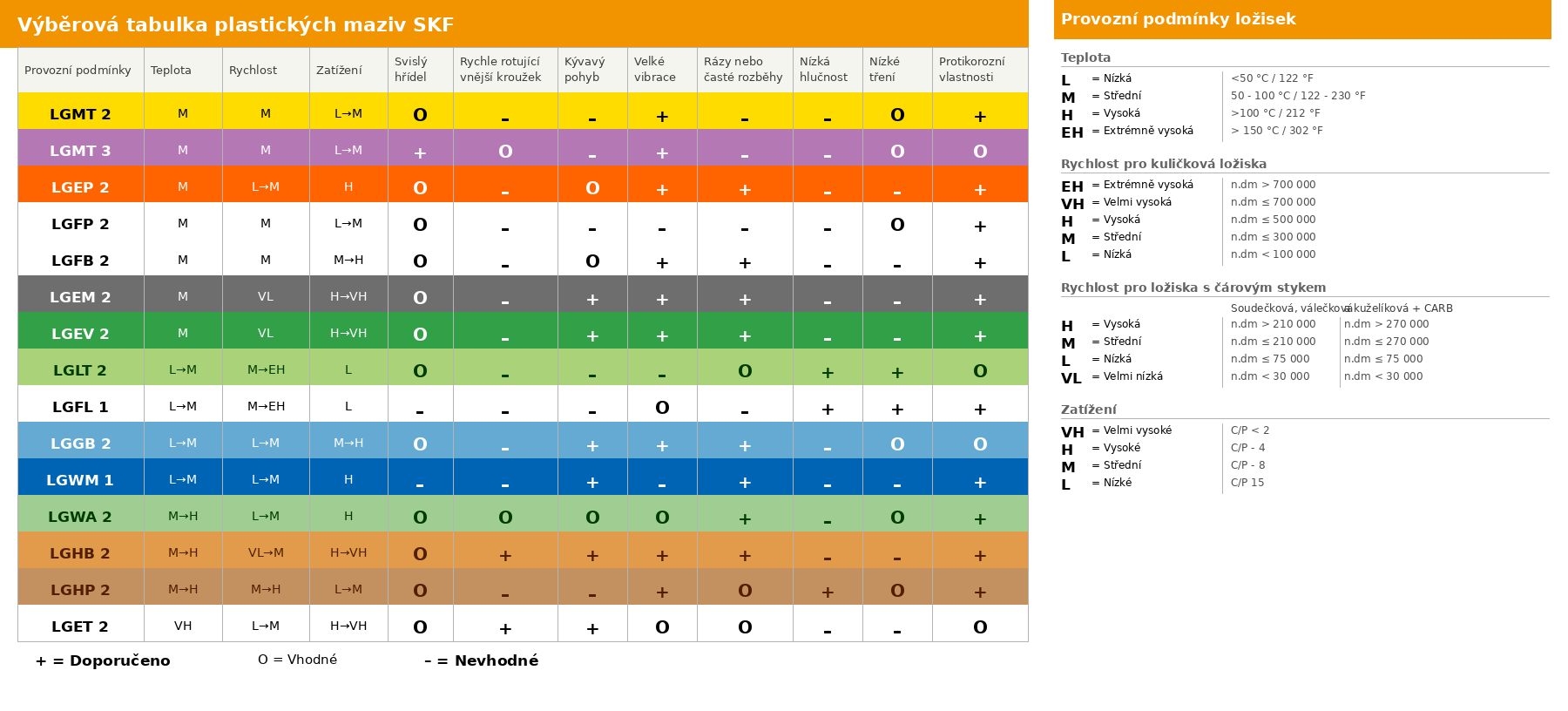
SKF LGHP 2
A premium mineral-oil-based grease with a modern polyurea thickener. Designed for operation in demanding temperature conditions where standard lubricants are not sufficient.
Properties:
- Operating temperature range from –40 °C to +150 °C
- High thermal and mechanical stability
- High corrosion protection
- Suitable for low-temperature startup
- Compatible with common polyurea and lithium-based greases
Where to use it:
Electric motors, industrial fans including high-speed ones, water pumps, bearings in textile and paper machines, clutch bearings, and applications with vertical shafts.

Schaeffler Arcanol Load 400G
High-performance grease specially developed for heavy-load and low-speed applications. Thanks to its exceptional load-carrying capacity, it ensures excellent protection against wear and corrosion, thereby extending the life of rolling bearings.
Properties:
- Operating temperature range from –20 °C to +140 °C
- High resistance to dynamic shock loads
- Low starting friction over a wide speed range
- Water resistance
- Suitable also for applications with a vertical shaft
- Base: mineral oil with lithium complex soap thickener
Where to use it:
Universal use in demanding operations with high dynamic loads – pins, plain bearings, swivel joints, agricultural and construction machinery.

ORLEN Liten LV 2-3
A reliable universal lubricant from the medium price range. Suitable for a wide range of industrial and standard applications where a specialized solution is not required.
Properties:
- Long-term operation at medium peripheral speeds in a wide temperature range
- NLGI consistency class 2–3 – suitable where a stiffer lubricant is needed that holds well in place
- Meets the ISO 6743/9 CCEA 2 and DIN 51 502 K2K-30 standards
- Good mechanical stability and oxidation resistance
- Suitable also for central lubrication systems
Where to use it:
Rolling bearings in standard operating conditions, plain bearings, small gearboxes with medium loads. Frequently used in bearings of electric motors, dynamos, alternators, and household appliances – as a long-term or lifetime fill without the need for relubrication.

KRAMP Multi-Purpose Grease
A multi-purpose grease based on highly refined mineral oils with a lithium thickener and EP additives. A reliable solution for standard and moderately demanding operating conditions at an affordable price.
Properties:
- Operating temperature range from –30 °C to +130 °C
- Resistance to high pressure and shock loads
- Consistency class NLGI 2, meets DIN 51 502 KP 2 K-30 standard
- Resistance to water and moisture
- Suitable for central lubrication systems
Where to use it:
Bearings of vehicles and construction machinery exposed to heavy or shock loads, pins and joints in dusty and damp environments. Thanks to its universal composition, it covers most standard lubrication points in operations.

Are you unsure which lubricant to choose?
The right lubricant is not selected just by brand or price. The application type, load, temperature, speed, environment, and relubrication method are important. For a more detailed guide, you can use the technical documentation of our suppliers.
The company SKF offers the online tool LubeSelect for selecting the appropriate grease based on specific operating conditions or application type. The user can either fill in basic operational data, based on which the tool recommends suitable lubricants according to the rules of SKF experts, or choose from pre-set profiles of common industrial applications.
However, it is important to take into account that the tool works with general rules and a limited selection of greases, so it may not cover all specific conditions of a particular operation.
Overview tables of SKF and Schaeffler lubricants are also available, in which you can find a comparison of individual products, their properties, temperature ranges, and recommended use.